Contact Form

Name

Email *

Message *

Showing posts with label 3d. Show all posts

Sunday, January 30, 2011

Close-Ups of Spider-Man On-Set!

On Location News has brought online some great close-up photos of Spider-Man on the set of director Marc Webb's Untitled Spider-Man Reboot, and we've posted a selection of them below. Coming to 3D and 2D theaters on July 3, 2012, the film stars Andrew Garfield, Emma Stone, Rhys Ifans, Martin Sheen, Denis Leary, Campbell Scott, Julianne Nicholson, Irrfan Khan, Annie Parisse, Chris Zylka and C. Thomas Howell.


Sunday, January 9, 2011

"Tangled" takes overseas box office crown

First place openings in 10 markets plus strong holdovers in German-speaking territories put the 3D animation retelling of the classic Rapunzel tale over the top. Foreign box office cumulative ticket sales now stand at $179.3 million in about 55 percent of the international marketplace. Including the U.S. and Canada, the global gross is now $355.2 million.

"Tangled" did gangbuster business in Brazil ($6 million) and Australia ($5.7 million). Solid success also came from Argentina, Colombia, Greece and New Zealand. "Tangled" now ranks as Disney's 15th biggest animation title ever released, and has yet to play key foreign markets such as the U.K., Spain, Korea and Japan.

Finishing No. 1 in nine markets -- seven of which were new -- was Sony's "The Tourist," which collected $26.2 million in 61 territories. Best of them was Russia where the opening tally was $10.3 million. The offshore gross for the romantic thriller starring Johnny Depp and Angelina Jolie has now reached $100.5 million.

Relativity Media/Atlas Entertainment's "Season of the Witch, starring Nicolas Cage and Ron Perlman, opened in the United Kingdom day-and-date with its U.S. bow and drew only a No. 10 U.K. ranking with an estimated $1 million.

Twentieth Century Fox's "Gulliver's Travels" starring Jack Black -- which narrowly finished in the No. 1 foreign box office spot last weekend -- dropped to No. 3 with a tally of $21 million.
LOS ANGELES (Hollywood Reporter) - After seven rounds as an also-ran on the foreign theatrical circuit, Disney Animation's "Tangled" finally nailed the No. 1 overseas box office spot with a weekend take of $26.3 million (£16.9 million) -- a mere $100,000 ahead of No. 2 The Tourist.

Wednesday, October 6, 2010

Real 3-D feature release numbers: the 3-D Revolution of 1953 and 1983 vs 2010

"Mankind has for centuries been moving toward stereoscopic cinema (yet) the bourgeois West is either indifferent or even hostilely ironical toward the problems of stereoscopic cinema"
Sergei Eisenstein, 1946


House of Wax (1953)


A current trend is advertisement of 3-D stereoscopic movies billed as 'Shot in 3-D' and billed as 'Also available in 2-D', besides 2-D films now being called 'in 2-D with normal ticket prices'.  This is a worrying development but historically speaking a predictable one.  Everybody knows there have been two major 3-D film bubbles in the past; in 1953/54 and in 1983/84, but not many people actually know why these 3-D bubbles burst and did not herald the era of 3-D film making.  What makes it difficult to compare the historic bubbles is the wildly different technical abilities of the different years, the difference in marketing, in targeting and in public spending power.  There has also been a feature film production and theatre runtime inflation: in the 1950's many fewer films were produced overall and they were playing in cinemas for a longer period of time as well.


Taza, Son of Conchise (1954)


An updated version of the 3-D Filmography
- the biggest and most accurate 3-D stereoscopic film list published anywhere - means a great chance to update the statistics.  After updating the 3-D filmography Gary Palmer, writer and editor of the list, made a very interesting remark about James Cameron's latest press statement which gave me the idea for combining the list, the statistics and the knowledge to come to a coherent image of what is going on with 3-D film and what may happen with it next.  What Gary pointed at was James Cameron saying he wanted the 3-D in Avatar - and in his future 3-D and 4-D films - to be unobtrusive and so much so that people will forget they are watching a 3-D film altogether (a bit hard with 4-D films, but there you go).  So then what is the point? 

When you pay a premium ticket price for a 3-D showing, you want to see 3-D and be reminded you are watching 3-D; I can't tell you how often I have heard people say they like this or that 3-D film, but were disappointed with the 3-D because it was too flat or 'was never used': coming out of the screen in an obvious fashion.  So that leaves us with the question: is today's 3-D content with its stereo window-inward quality really better than yesterday's 3-D that used much more of the negative parallax space and is this more subtle content the reason 3-D appears to have more staying power this time around?

Monsters VS Aliens (2009)


There is a lot of PR wah-wah about why today's 3-D is so much better than that of the 1950's or 1980's, but of course the complete truth is never spoken.  It would be too uncomfortable to discuss technologically sound 3-D projection in the 1980's or more grown up 3-D film content in the 1950's and so journalists keep on copy-pasting the original blurb put out by Real-D and James Cameron 3 years ago.  Shame on the critic who claims 'Piranha 3D' or 'My Bloody Valentine 3D' are better technically or creatively than 'House of Wax' or 'Dial M for Murder'!

Polarized projection: from 1952 onward


3-D Price Premium


There was mostly no ticket price premium for 3-D films in 1953 and 1983 and thus the studios had to carry the extra cost of their 3-D productions.  When attendance numbers went down, the 3-D revolution was over as quickly as it started in those two occasions.  Today, studios and distributors have merged, own the multiplexes in which their films are shown and have a strong presence in the TV and DVD side of distribution.  Because of this, the 3-D premium at the box office and the 3-D BluRay price premium is keeping today's 3-D revolution alive and well.  If 3-D ticket prices are forced down by lower attendance, 3-D movie production will be heavily reduced, or, more likely, the premium price for 3-D film viewing will become the standard for 2-D film attendance as well - a scenario where 3-D film production will go down as well because 2-D film will always remain cheaper to produce.

There may well be another reason for today's film studios' push for 3-D: it moves the bulk spending from post production back to the principal photography - back to the studios.  This is, because once shot or rendered, 3-D film can barely be 'fixed' in post - only very minimally so - before heavy distortion of the image occurs.  So the power is back in the hands of the DOP and camera makers.

3-D Filming in 1983 using the Arri 3-D lens adapter


3-D Film Favourites: Horror, thriller and Western

Not many people realize this, but in 1953/54 most 3-D films released were dramas and Westerns (30%).  This number was closely followed by action and western movies (20%) and horror and thriller movies (17%).  As the 3-D bubble collapsed in 1954, the same amount of 3-D movies as planned during the current stereoscopic craze were cancelled in 3-D and shot in 2-D.  In most cases, CinemaScope had little to do with this as these films were pretty much all still released in 1.85 format.  The real interesting question lies with the kinds of movies released in 3-D in this era and whether they were suitable for the 3-D process - and thus whether this might have had anything to do with the collapse of 3-D film in 1955.  I just don't buy the argument that it was purely technical issues with 35mm film projector synchronizing, alignment (weave) and the cardboard polarizing glasses.  This argument falls apart when the 1983/84 3-D boom is considered with its single lens / single film strip polarized colour film projection.

Polarized 3-D projection before Digital Cinema


In the current 4-year 3-D film release growth of 2008-2012 the emphasis of type of film lies heavily on animation (38%), followed by horror / thriller (22%) and sci-fi / fantasy (17%).  Of course the high numbers for animation have a lot to do with the current lower age and family-oriented target for film releases and the fact that CGI animation production finds a natural form in stereoscopic 3-D presentation - the step to go 3-D is relatively speaking most easy with CGI animation production.  In this way, animation has actually been a large driving force for the current 3-D cinema release trend, but the number of animation film releases in 3-D cannot, realistically, be put against other historic numbers, as animation production is completely different from what it was 30 and 60 years ago.  What is a real historic benchmark are the horror / thriller and sci-fi / fantasy film numbers (one can call sci-fi / fantasy the present day Western and romance / comedy has been moved into animation).  In these numbers there is a visible shift from horror / thriller to sci-fi / fantasy as the 3-D boom continues into 2012 - a shift to a much larger family audience (more movie tickets and 3-D BluRays to be sold) and a shift away from cheap thrills, towards grand spectacle.  However, grown up drama, war, documentary and comedy are still not in the 3-Dimensional picture and film makers continue the hundred-year trend of not taking 3-D film serious when it comes to content.

A note on 2-D to 3-D converted titles then: this is a practice impossible in the 1950's and 1980's.  16-26% of the 3-D releases of the years 2009-2012 are dimensionalized 2-D to 3-D conversions and although they wouldn't have existed as 3-D films before 2006 (Nightmare before Christmas), they are in the end still 3-D film releases.  Quality of the 3-D is not debated here.

The Nightmare Before Christmas (2006)


Scheduled 3-D stereoscopic feature film releases:


1953:
45 titles released (Total of 1,845, of which 2.5% in 3-D)
16 titles announced but not released in 3-D

Animation:  0
Horror / Thriller:  6
Action / Western action:  8
Documentary:  2
Sci-Fi / Fantasy:  2
Music/Dance:  4
Drama / Western drama:  16
War: 1
Adult: 1
RomCom: 5


1954:
19 titles released
24 titles announced but not released in 3-D

Animation: 0
Horror / Thriller: 5
Action / Western action: 5
IMAX / Docu: 0
Sci-Fi / Fantasy: 2
Music/Dance: 1
Drama / Western drama: 3
War: 0
Adult: 0
RomCom: 3


1983:
17 titles released (Total of 3,122, of which 0.5% in 3-D)
4 titles announced but not released in 3-D

Animation: 0
Horror / Thriller: 4
Action / Adventure: 3
IMAX / Docu: 0
Sci-Fi / Fantasy: 4
Music/Dance: 0
Drama: 2
War: 0
Adult: 3
RomCom: 1


1984:
7 titles released
1 titles announced but not released in 3-D

Animation: 0
Horror / Thriller: 2
Action / Adventure: 0
IMAX / Docu: 0
Sci-Fi / Fantasy: 2
Music/Dance: 0
Drama: 0
War: 0
Adult: 2
RomCom: 1


2008:
9 titles

Animation: 2
Horror / Thriller: 2
Action: 0
IMAX / Docu: 0
Sci-Fi / Fantasy: 1
Music/Dance: 1
Drama: 2
War: 0
Adult: 1
RomCom: 0


2009:
37 titles (21 minus animation) (Total of 6,522, of which 0.5% in 3-D)
Dimensionalized: 6

Animation: 15
Horror / Thriller: 8
Action: 1
IMAX / Docu: 3
Sci-Fi / Fantasy: 4
Music/Dance: 3
Drama: 0
War: 0
Adult: 3
RomCom: 0


2010:
77 titles (48 minus animation) (Total of 7,735, of which 1% in 3-D)
Dimensionalized: 20

Animation: 29
Horror / Thriller: 22
Action: 3
IMAX / Docu: 3
Sci-Fi / Fantasy: 11
Music/Dance: 5
Drama: 1
War: 0
Adult: 3
RomCom: 0


2011:
43 titles (28 minus animation) (Total of 3,933, of which 1% in 3-D)
Dimensionalized: 8

Animation: 15
Horror / Thriller: 6
Action: 5
IMAX / Docu: 1
Sci-Fi / Fantasy: 12
Music/Dance: 0
Drama: 4
War: 0
Adult: 0
RomCom: 0


2012:
6 titles (3 minus animation) (Total of 1,436, of which 0.5% in 3-D)
Dimensionalized: 0

Animation: 3
Horror / Thriller: 0
Action: 1
IMAX / Docu: 0
Sci-Fi / Fantasy: 1
Music/Dance: 0
Drama: 0
War: 1
Adult: 0
RomCom: 0
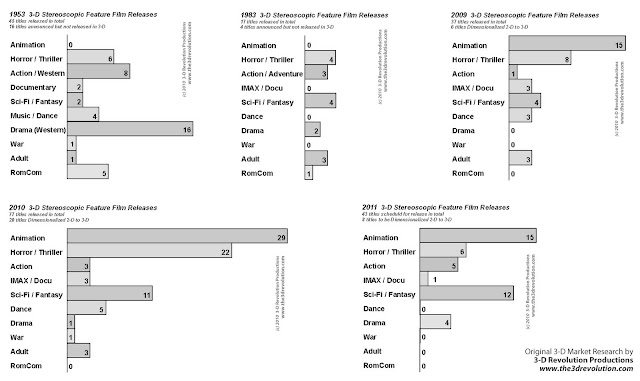


So can we draw conclusions from these numbers?  One can say something about types of film and suitability for the 3-D process but a better perspective is gained when 2-D film genre releases are set against the 3-D numbers.  The numbers appear to be roughly equal in percentages, so one can state that 3-D film release mirror 2-D film releases for genre, or that most 3-D film producers decide to 'go 3-D' mid-production of a 2-D film. 

In absolute numbers, the number of 3-D releases has jumped up from 0.5% to 1% (no 3-D revolution yet) and when animation and 3-D conversion titles are subtracted from the present day totals, the number of 3-D feature films released in 1953 is still more than double that of today's 3-D resurgence on a year-by-year basis.  Does that really matter though if today's 3-D boom is a continuous one?  The infrastructure for incidental 3-D film release is now in place and unless all the Real-D, Dolby3D and Xpand projector adapters are all on hire or on short-term maintenance contracts, releasing a film, or parts of it, in 3-D will remain a real option for future film producers.

Alexander Lentjes is available as Consultant or Production member for your 3-D Stereoscopic animation or live-action television or feature film production.  More information and Contact details at www.the3drevolution.com/contact.html


Friday, October 16, 2009

3-D Film formats beyond Real-D, Dolby3D and Xpand 3-D

Side by Side Film
Digital 3-D projection is fantastic and the way forward for a prosperous future of 3-D, but despite all the huffing and puffing of the Avatar PR machine, 3-D film consumption at home is still 99.9% an anaglyph business. In recent weeks, anaglyph family member ColorCode 3D has been the main format chosen for 3-D TV broadcast in the US and the UK. While we are all familiar with the pro's and con's of the amber-blue di-chromatic system, it can still not be called much more than a clever rehash of the original stereoscopic format: anaglyph. But then, when it comes to 3-D, there has historically so far always been a constant re-invention of the wheel with few meaningful exceptions.

What can strike many as odd is that patents are granted time and again for 3-D display systems that do nothing new compared to long time existing systems. Sure, it is good for business when technologies are protected, but to lock away existing formats that have been with us for 150 years behind lawsuits and license fees may prove to be a crippling blow to an already fickle, unstable industry. What we need to do now is open up the knowledge and share the technology, or a 3-D industry will yet again not be able to establish itself properly and return to the small club of elites in the 3-D know.

Throughout the years, in 3-D feature film production, the 5 stereo encoding systems of Twin Strip, Side-by-side, Over-under, Lenticular and Anaglyph have been used and patented under many different names. 102 to be precise. Hosting the 3-D Filmography at the3drevolution.com, I have been able to compile the following 3-D feature film format names list for your reading pleasure. I personally love the crazy, wild names and I would hate to see the tradition of the invention of a 'new' zany 3-D process with every film release disappear. But, like with the non-use of negative parallax by 3-D film makers these days, the trend is getting more and more disappointingly dull: the '3-D' is mentioned as much as possible in advertising but just as that: 3-D. Or maybe 'Digital 3-D' (and, of course, Real-D and IMAX 3D), but no longer 'SpaceTerrorScopeVision 3-D'. Does it really remind people of bad 3-D experiences of the 1950's? I seriously doubt it. It is not like throwing a pick-axe at the camera in Real-D 3-D is any different as a film-going experience than seeing it hit the negative parallax barrier in StereoVision. I think the trend has more to do with the 'if it's digital, it's got to be good' attitude, regardless of the fact that two digital cameras will still need to be strapped together on a real world slide bar. And if you ask me, the act of aligning the cameras can and should still be called 'StereoCineScope-a-Rama' whenever possible, even when it doesn't sound very digital.

On to the list then. Some of the names refer to the technique in which the film was shot shot, some to the format it was printed in. Because, to give just one example, you can shoot over-under as well as printing in the format.


Glorious 3-D in Twin strip (dual source) format has been known under the name of:

3-D Video, 3Vision, Ciné Stéréo Télévision, Clear-Vision, Columbia 3-D, Depth Dimension, Dimension 3, Disney 3-D, Dual-Techniscope, Dual-VistaVision, Dynoptic 3-D, Fairall Process, Freddy Vision, Friese-Greene Stereoscopic Process, Fusion 3-D (Reality Camera System), Future Dimension, Hi-Vision 3-D, IMAX 3-D, Iwerks 3-D, Kwong-Tzan 3-D, Lipton Three-Dimensional Filmmaking System, Loucks & Norling 3-Dimension, Maurer 3-D, Metroscopix, Metrovision Tri-Dee, Miller Stereoscopic Process, Monogram 3-D, Natural Vision, Natural Vision 3-Dimension, NFBC 3-D, Norling-Leventhal 3-Dimensions, nWave 3-D, Paravision, Parkes 3-D, Parrish 3-D, Pathé 3-D, Plasticon 3-D, Plastigram 3-D, Pola-Lux 3-D, Porter-Waddell Stereoscopic Process, PSC 3-D, Ramsdell 3-D, Richardson 3-D, Sensorama, Showscan 3-D, Spacemaster 3-D, Stereo Base and Stereo-Cine.


Side by Side straight, rotated, anamorphic or in any other combination can also be called:

3D30, Bolex Stereo, Dudley 3-D, Elgeet Stereo, LazerVision, Nord 3-D, Optovision, Pola-Lite, Powell 3-D, Quadravision 4-D, Raumfilm-System, Shochiku Natural Vision, Sistema Gaultiero Gaulterotti, Stereokino, Stéréoscopic Lumière, Stereo 70, Stereovision 70 (Hi Fi Stereo 70, Triarama, Super Cinema 3-D), Tri-Delta Stereo, Western 3-D, Wolff 3-D and Wondavision (Deep Throw 3-D).


Over Under (above/below) has been recording and projecting 3-D film under the name of:

3-Depix, 3-Dynavision, ArriVision, Cinedepth, Cubic 3-D, ESI-3D, Fuji Vision, Future Dimensions, Hi Stereo Vision, Impact 3-D, McNabb 3-D, Optimax III (Dimensionscope), Plasztikus Film, Spacevision, StereoVision (Future Dimensions), StereoVision TenPerf 70, Super Touch 3-D (Real-a-Rama, Super 3D, Ultra-Cubic 3-D) and Z3D.


Checkerboard, lenticular and raster encoding is more something of a post production format, but one 3-D system manages to already shoot in it:

Cyclostéréoscope.


Anaglyph (di-chromatic), the grand daddy of them all, is also known by the name of:

3-Dimensions, 3D Plus, ColorCode 3-D, Cosmovision, DeepVision, HorrorScope (MiracleVision), Natural Vision 3, Smart Anaglyphic Fatigue Eliminator, Triangle 3-D, Trioscope and Trioviz.


And that's it. If your very own invented (or favourite) stereo format is in this list, but put in the wrong category, or does not feature in the list yet, please do contact me so that the misplacement can be rectified. The list aims to be correct and precise as possible - a challenge in these hairy days of Wild West 3-D reinvention and land grabbing!

Contact Alexander Lentjes by e-mail.
The 3-D Filmography can be found at: www.the3drevolution.com/3dlist.html


Tuesday, September 1, 2009

A future of 3-D through the eyes of Blue Alien Giants

A future of 3-D through the eyes of Blue Alien Giants

As published in this month's Veritas et Visus magazine


It is being heralded as the 3D movie that will single-handedly save the stereoscopic industry, or, rather, kick-start it into full gear and propel it into the common man’s cinema diary and living room. Avatar.

Avatar 3-D posterAll stereographers talk about it with awe and expectation, while salesmen of 3-D hardware excitedly shout out its name. But what is Avatar? A high-concept science-fiction film of the purest kind. Space marines, alien planets, a war between man in spaceships and helicopters and exoskels with machine guns and a jungle-bound alien race of blue giants.

Some would describe it as effects for effects’ sake, but whatever the case, it doesn't sound like a broad audience movie. By all accounts Avatar should have been a niche market film, appealing to young men and even younger boys. Are our mothers and wives going to want to invest emotional energy into giant blue warmongering aliens? They have spoken in their billions and have said and unequivocal 'Yes'. Sci-fi is mainstream again in 2010, especially when it's in 3-D.

It would appear that the largest part of the cinema-going and movie-buying audience does not need to be convinced that wearing 3-D glasses is not stupid, annoying or even uncomfortable any more. At least not in the cinema. Dissing anaglyph glasses is still not the way forward though, because it is the diss that is remembered, not the difference between dichromatic and polarized image separation. Yes, glasses could be physically more comfortable, but that does not take away the psychological barrier most people experience when faced with the prospect wearing them over their TV dinner.


Honestly, you won't look like Nerd, nor will you go bald when you wear 3-D specs

So how can we remove this inbuilt reluctance and fear? By presenting the doubters and cynics with their favorite content in really well shot 3D and letting the power of word of mouth do its job.

In my opinion the key to a 3-D future lies in the romantic comedy, the costume drama and the psychological thriller. Taking real numbers as found on IMDB, less than 1 in 10 movies produced overall is a science-fiction or fantasy film (6%), 1 in 10 movies is a family film (including animation, 10%) while 5 in 10 movies are a romantic comedy / drama (47%), yet when it comes to 3D movies slated for a 2009 release, 3 out of 10 movies is a science-fiction / horror / action film (33%), almost 4 out of 10 is animation / fantasy / music (35%) and just more than 2 out of 10 is a documentary (24%). The remaining 1 out of 10 movies (9%) is reserved for music specials and naughty movies, while no romantic comedies of drama films are slated for 3D release. How can there possibly be proper penetration of stereo 3D as a mass-audience medium if the main types of cinematic story are not told in 3D? If Sandra Bullock and Meryl Streep don’t look good in 3D, don’t even bother trying to sell the 3D Ready LCD screens.


In terms of broadcast TV, cooking programs and reality shows will have to work with 3D to make financial sense. Again, sales men are focusing all their energy on sports broadcasts and thus targeting boys and men. But what is one football match in a sea of time-filling content such as that of The Apprentice, Strictly Come Dancing, As the World Turns, Oprah Winfrey and Jerry Springer? That is what the reality of a 3D stereoscopic future is all about. We all know a tomato will look fantastic in 3D and that bargain diamond ring on QVC’s home shopping channel will sell very well when it pops off the screen, but what about book reviews and embarrassing celebrity reality filler? I, for one, will not feel enticed to don 3-D glasses to watch animals do the funniest things – in 3-D. But perhaps I just don’t know what I’ll be missing yet...


Oh yeah - LOLcatz in 3-D. It's the future of entertainment!

On the production side of things the only way for a true 3D switch-over to happen is complete standardization and idiot-proofing of recording, playback and delivery hardware. Of course us stereo experts will all be out of a job when everything is standardized and built-in, so we can all enjoy long weekdays in front of the 3D television. Fixed interaxials for studio shoots, fixed minimum distances to the camera, no more convergence control and a pipeline that allows for previewing and editing in the final screen size of choice all the way. No more need for lookup tables and heated discussions over what to do or not do in 3D.


Producers want a straight off-the-shelve stereoscopic camera and pipeline solution and that’s what they will get. We will see a return to cameras with three fixed lens options as standard in the 1950s and 60s. But what is the bulk of 3D films to be produced with such standardized equipment going to look like? Creative 3D control will go out the window. On most productions, that should actually be a blessing though: watch one movie with divergence and vertical parallax and you will agree with this point.

Experience is everything in 3-D shooting and even then, with veteran stereographers at
the helm, eyestrain can creep in. Automatic, real-time vertical parallax detection and correction hardware will remove the strain of having to precisely align a 3-D camera rig before every shot. Miniature cameras and lenses will mean effortless, small and light 3-D rigs that don’t even
look like they contain 2 cameras or lenses. And to top everything off, image capture will happen with inbuilt retinal rivalry correction and will be dual-stream compatible all the way down the pipeline without you even noticing it.


No more heavy camera rigs in the 3-D future

Will you still be excited about 3-D in this future? Well no, because it will be a normal, every-day, run-off-the-mill format – unless we will shoot extraordinary content in it and produce visual stories that have never been seen or experienced before. And although Avatar may be breaking new ground in terms of VFX and live-action integration, it is its story and characters that are going to determine whether we will want to see more science fiction films about giant blue aliens in 3-D.


Blue Aliens are all the rage!


Wednesday, April 29, 2009

3-D LinkedIn Group and Dimension 3 Expo


Update (September 2009):
The Stereoscopic 3-D Professionals Worldwide LinkedIn Group now has over 2,300 members.

The Stereoscopic 3-D Professionals Worldwide LinkedIn Group is growing rapidly on a daily basis and now has over 1,600 members. The 1,500 mark passed so quickly that I didn’t even have time to announce it! Members now include professionals from virtually all key companies in the 3-D Stereoscopic industry and of course most of the key 3-D Stereoscopic independent professionals on the globe as well. Check it out:
http://www.linkedin.com/groups?gid=51511

This plethora of 3-D professionals translates into very effective discussion forum postings and job postings getting answered by exactly the right people in no time. And the amount of 3-D jobs appears to be growing rapidly, despite the global recession. Through the group it is possible to find real, professional answers to your stereoscopic questions, find 3-D colleagues, meet new business partners and set up meetings at international 3-D events to meet any of the 1,600 members in person.

In that respect I would like to draw your attention to the upcoming Dimension 3 Expo in Paris, France, from 2-4 June 2009. D3E is Europe’s premier, biggest and most dedicated event revolving around 3-D Stereoscopic media production and display and is THE place to meet European stereoscopic 3-D professionals and manufacturers. NAB and IBC may have bits and bobs on 3-D, Dimension 3 Expo is purely dedicated to Stereo 3-D. More practical information on D3E at the website:

www.dimension3-expo.com


As I will be sitting on one of the panels of the Dimension 3 conferences (Wednesday 3 June - 2 pm), D3 is the perfect opportunity to meet me in person as well and I do indeed intend to organize LinkedIn 3-D Group drinks in one of the local bars. This will be a perfect opportunity to put faces to names of the group and talk advanced, ground-breaking and avant-garde 3-D with like-minded 3-D professionals. If you are interested in sponsoring the drinks, please do contact me: info [at] the3drevolution.com


Recognize Alexander Lentjes
at Dimension 3 Expo 2009


Announced attendants to D3E so far:

2AVI, 3D-Filme, 3DLized, 3D Revolution, 3DTV Solutions, 21st century 3D, 3D Entertainment, Alcorn, Alioscopy, AmaK, Apy, Artistic Images, Assimilate, Attitude Studio, Autodesk, BskyB, Beinrelief, Christie, CNC, Color Code, CowProd, Cube, Dassault Systèmes, Herold & Familly, Digimage Cinema, Disney Pictures, Dolby, Doremi Cinema, DPLenticular, Eutelsat, Geopack, Gobelins, Imax, Inition, In-Three, Iridas, Iz3D, Fraunhofer Institute, le Futuroscope, Geneva Film, Geopack, HDCC, Holo Image, Jon Peddie Research, Kolpi, Kuk Film Production, La Geode, La Ficam, L’Ecole Nationale Louis Lumière, Le Pôle, Lightspeed Design, LocaRed, Mercenaries Engineering, Nayade, Next3D, NVIDIA, Nwave, Orange, Panasonic, Passmore Labs, Planar, Polymorph, Principal Large Format, P+S Technik, Quantel, Samsung, Sensio, SMPTE, TeamTo, Tempere University of Technology, Thomson, Trioviz, R2D1, SMPTE, Swiss Rig, Sky High Entertainment, The Foundry, N3DLand, National Geographic, Nwaves, Universal Pictures, Université CRC, UP3D, Volfoni, Wild Bunch, Wow Factor Pictures, Xpand


I hope to see you there!

Alexander Lentjes
3-D Revolution Productions
www.the3drevolution.com

DiggIt!Del.icio.usBlinklistYahooFurl TechnoratiSimpySpurlRedditStumble UponAdd AnyWindows Live