When reading recent articles about
3-D Stereoscopic production in the 21st Century, one cannot escape being snowed under by slick corporate press release material rather than being presented with
objective news and facts about
3-D Film production. A recent article in a prominent and well-read television & film industry magazine provides a very good example. It published so many unresearched, uncritical, copy-pasted press release material that I decided to spring into action and reply to the editor-in-chief regarding the gross inaccuracies. Of course, an editor will never admit to these kinds of mistakes and no confirmation of receipt was ever sent back, so here are the article extracts and my responses to them for your
3-D fact finding pleasure.
---
Article:"The presentation of films in 3D is as old as the movie business itself, but clumsy technology and unrealistic effects have so far kept it out of the mainstream."
Reply:The 3-D boom of 1953-54, when over 100 Hollywood 3-D feature titles were released, did so using twin-camera filming and polarized projection - the only difference with today's technology being that it was done on 35MM film, rather than on HD video. You have clearly never seen a twin-projected film from 1953, as most of them blow today's 3-D releases right out of the water in terms of a 3-D cinematic experience. The claim of "unrealistic effects" is based on nothing, as exactly the same 3-D compositions, shots and camera moves are employed today as they were then.
Article:"The technology to achieve and watch 3D has come a long way since cinema-goers wearing red and green glasses leapt from their seats during Jaws 3D. That was in 1983, when a film created for traditional projection was then rendered into 3D in post-production."
Reply:Sorry, but this is completely based on fantasy and, I strongly suspect, misinformation supplied by modern day 3-D camera system providers.
Jaws 3-D was shot with a 3-D camera adapter called
StereoVision, on 35MM film. This was then projected using, as in 1953, polarizing projection lenses, but this time using special
StereoVision projector adapters. The beauty of that system is that it all worked with existing technology and standards of the time - unlike today's need for digital switch-over before 3-D can be presented. No red-blue anaglyphs were ever used to project this movie other than maybe for poor cinemas in the Asian subcontinent and lagging-behind (or poorly supplied) Europe!
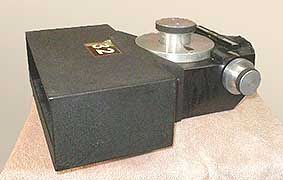
StereoVision 3-D adapter for 35MM film camerasArticle:"The high resolution of the twin digital images can now be maintained not only in post-production but through to distribution and exhibition, as digital cinema systems replace 35mm print reels and projectors."
Reply:I have to remind you about 70MM film 3-D presentations that were done in the 1970s - no newer format other than IMAX has ever gotten close to that image quality. And although digital projection is obviously more stable than 35MM projection, the eyes cannot distinguish between 35MM film projection of 3-D and digital projection of 3-D.
Article:""There are very few technical challenges left for deploying 3D," declares Joshua Greer, president of RealD, which holds a monopoly on 3D presentation systems."
Reply:There are at least 3 competing big name digital 3-D projection systems on the market, being
Real-D,
Dolby 3-D and
NuVision, although I can understand that Joshua Greer would like to see that point differently. It is true, though, that Real-D does have the most aggressive marketing strategy and has managed to convince more theatres than any other 3-D projection brand to incorporate their technology in the new digital projection rooms.
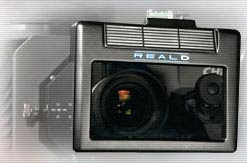
Real D Projection adapterArticle:"Four releases to date have suggested that 3D could drive studio profits in the next decade. Disney's Chicken Little, Meet the Robinsons and The Nightmare Before Christmas 3D and Sony's Monster House all earned three times as much revenue per screen as the 2D version of the same film on their first weekend of release."
Reply:The real fact is that the cinemas showing these movies charged more for the cinema tickets, explaining the higher profits. So although 3-D can mean higher revenue in the short term, it is not a sustainable and realistic business model in the long term, as consumers will not continue to pay higher prices for their cinema tickets. Will you? Especially if 3-D becomes something of a standard?
Article:"It also currently costs an extra US$10m-15m to make a 3D movie"
Reply:Compared to what exactly and for what kind of a movie? Animation will quickly cost 130-150% in 3-D, while live-action will easily cost 150-175% of a regular movie. Talk to any stereographer and 3-D consultant like myself and you will hear the same numbers.
Article:""None of the 3D systems in the past allowed you to immerse yourself in the frame," Walden Media CEO Cary Granat tells Reuters."
Reply:I am sorry, but that is just pure nonsense. Go and see 1953's 'House of Wax' or 'Dial M for Murder', followed by 'Chicken Little' or 'Meet the Robinsons' and have another look at that statement. Immersing yourself in the frame with 3-D is everything to do with the 3-D camera work, not the technology. And they did that a hell of a lot better in the 50s and 80s than they are doing right now.
---
If you are a journalist or an editor and you would like to learn more about 3-D Film, from a more accurate perspective, I will be more than happy to write you a piece on the subject. Large and well-respected magazines like
Animation Magazine have already published some of my writing on 3-D focusing on
3-D stereoscopic animation production and the technical and creative implications of 3-D filming and animating.
Alexander Lentjes3-D Revolution Productions


 The official Movie Poster even refers to the 3-D eye poking


